TEMPTATIONA Little Bean With a Lot of WallopBy ALEXANDRA ZISSU
 HE
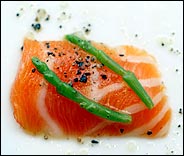
green objects resting on top of bias-cut rectangles of raw king salmon belly
at Craft are not a garnish. Nor are they pieces of basil branch or sprigs
of a strange new hybrid parsley. They are sea beans. And, for something so
small they are remarkable. HE
green objects resting on top of bias-cut rectangles of raw king salmon belly
at Craft are not a garnish. Nor are they pieces of basil branch or sprigs
of a strange new hybrid parsley. They are sea beans. And, for something so
small they are remarkable. Sea beans, a marine plant with many names
— samphire, poor man's asparagus, pickleweed, salicornia, pousse-pied, to
name a few — are half seaweed and half green. They come cultivated or wild.
Uncooked, they taste like an inadvertent swallow of seawater, so they are
best quickly blanched to remove some saltiness, then shocked in ice water.
In this state, they can be reheated and seasoned, or dressed cold.
Craft prepares sea beans simply: after an ice bath, they are pickled briefly
in diluted white wine vinegar, then set aside for use on the salmon belly,
at which time they are sprinkled with fleur de sel and black pepper and drizzled
with olive oil. The pairing looks like summer: the pink and green color of
a watermelon (or a Lilly Pulitzer dress.) The acid in the sea beans
cuts the flavor of the fatty salmon just so. A pickled sea bean is half an
inch long, but packs the crunch of a crisp Kirby cucumber, which makes for
a delightful juxtaposition.
An appetizer of raw salmon belly with pickled sea beans is $16 at Craft, 43 East 19th Street (near Broadway); (212) 780-0880.
Home cooks can sometimes find sea beans at the Grand Central Market or at
the Manhattan Fruit Exchange at Chelsea Market ($9.99 a pound).
|